Customer Discovery Interviews: A 35-Minute Script That Avoids Polite Lies
A step-by-step customer discovery playbook: who to recruit, a 35-minute interview script built on past behaviour instead of opinions, how to take comparable notes, and a three-signal score that turns ten customer interviews into a decision.
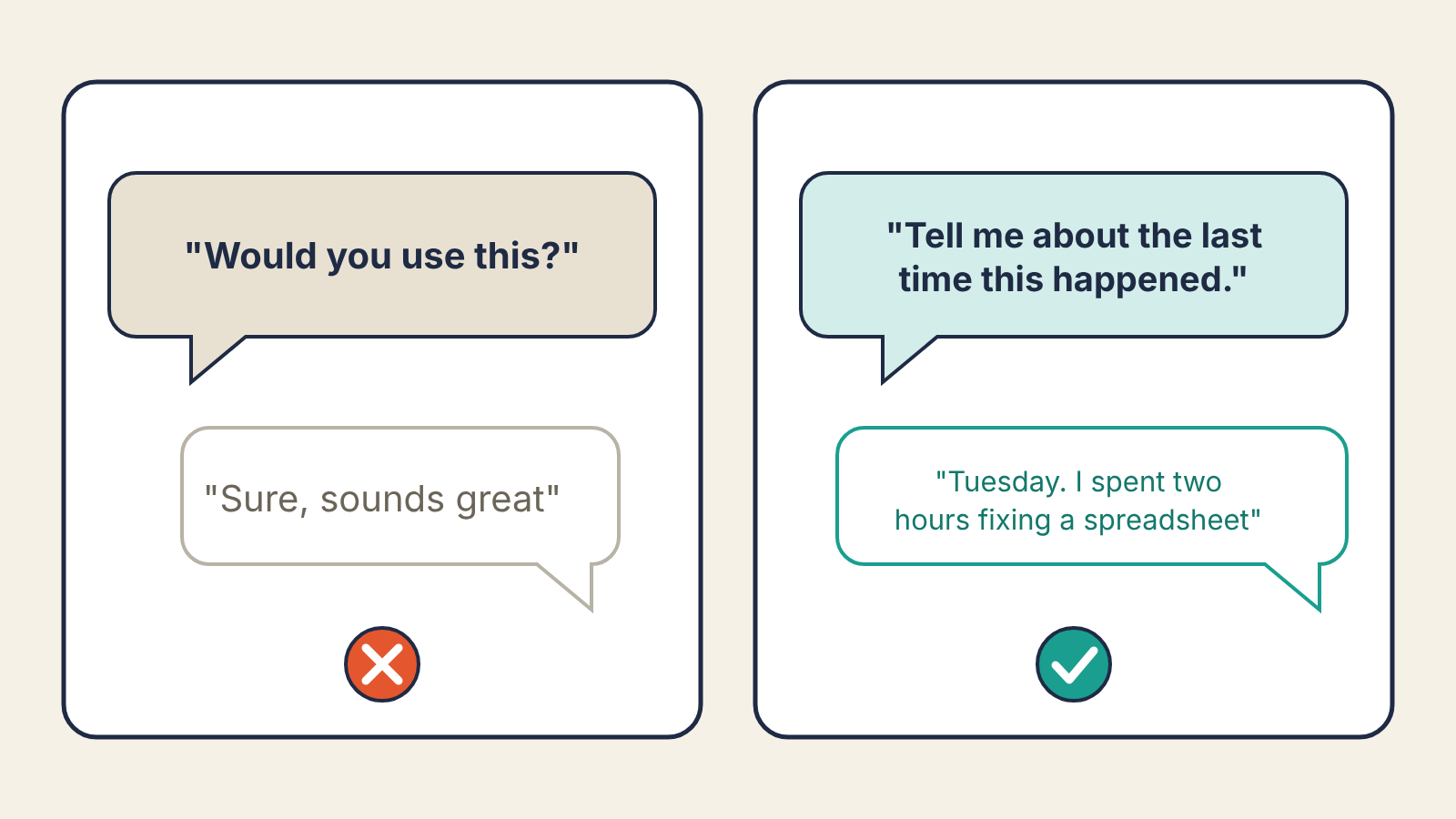
A customer discovery interview works when you ask about what people already did, not what they would do. "Would you use this?" gets a polite yes that predicts nothing. "Tell me about the last time this happened" gets a story with dates, tools, costs and annoyance, and that story is what tells you whether the problem is worth solving.
This playbook gives you the full method: who it suits, how to recruit, a 35-minute script, and how to score the answers so ten interviews turn into a decision.
Who it is for: founders before or just after an MVP, and product managers testing a new problem area. Time needed: about a week for 8–12 interviews, plus two hours to synthesise. Sample size: enough interviews that new ones stop surprising you. For a narrow segment that is often around ten; if answers are still all over the place at fifteen, your segment is too broad.
Why opinions fail and stories work
People are kind to founders. Ask them to judge an idea and most will praise it, because criticism is awkward and agreeing costs nothing. They also predict their own behaviour badly: plenty of people who say they would pay for something never do.
Rob Fitzpatrick's book The Mom Test turned this into the rule most discovery practice now follows: talk about their life instead of your idea, ask about specifics in the past instead of generics or the future, and listen more than you talk. The script below is built on that rule. It never describes your product until the last two minutes, and only if you choose to.
Step 1: Recruit the right people
Pick one segment you can describe in a sentence, such as "operations leads at 20–100 person logistics companies who run weekly carrier invoices". Then find people who match it through your own network, communities they already use, and introductions from earlier interviewees.
Screen with one factual question before booking: "When did you last deal with [the problem]?" If the answer is "not sure" or "a few months ago" for something you think is weekly, skip them politely. You learn little from people who do not have the problem.
Avoid friends and family unless they are squarely in the segment, and do not pay so much that people show up for the money. A modest gift card or a donation is enough for most B2B interviews.
Step 2: Run the 35-minute script
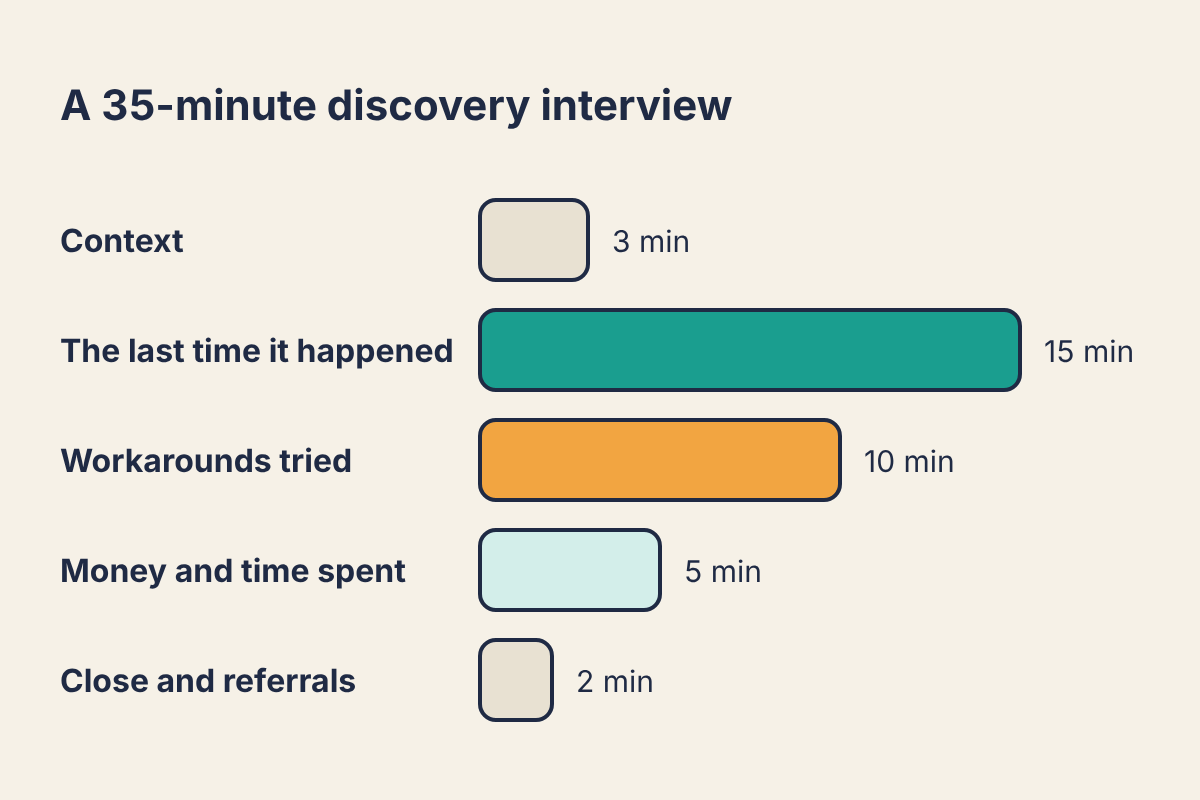
Ask the questions in this order. Follow up on anything specific; skip anything they have already answered.
Context (3 minutes)
- "What does your role involve day to day?"
- "Where does [the problem area] fit into that?"
The last time it happened (15 minutes)
- "Tell me about the last time you had to [do the task]. When was it?"
- "Walk me through it from the start. What did you do first?"
- "Which tools or people were involved?"
- "What was the hardest or most annoying part?"
- "What happened as a result? Did anything go wrong?"
Keep pulling the thread with "then what?" and "why was that?". If they drift into generalities ("usually we..."), bring them back: "Thinking about that time on Tuesday specifically, what happened?"
Workarounds (10 minutes)
- "Have you tried to fix this? What did you try?"
- "What do you use now? What do you like and dislike about it?"
- "Why did you stop using [the thing they abandoned]?"
A person with a real problem has usually tried something: a spreadsheet, a script, a hire, another tool. No workaround at all is a warning sign that the problem is not painful enough to act on.
Money and time (5 minutes)
- "Roughly how much time does this take you in a typical week or month?"
- "Do you pay for anything to deal with it today? Who approved that?"
- "If this went away tomorrow, what would you do with that time?"
What they pay today is the anchor for pricing later. Keep price questions about your own product out of the interview and save them for a Van Westendorp willingness-to-pay survey once people have seen what they would get.
Close (2 minutes)
- "Who else should I talk to about this?"
- "Can I follow up if I build something to test?"
Two referrals and a yes to follow-up is a good sign. Hesitation on both, after a long complaint, often means the problem is real but not theirs to solve or buy for.
Step 3: Take notes you can compare
Write up each interview within an hour, using the same headings every time: the last story in their words, workarounds tried, time or money spent, who decides, and any phrases they used to describe the pain. Record calls only with permission. Note facts and quotes separately from your interpretation, so you can tell later what they said from what you hoped.
Step 4: Score the interviews
After eight to twelve interviews, score each one on three yes-or-no questions:
- Recent: did the problem happen in the last two weeks (or the last cycle, for monthly tasks)?
- Workaround: have they spent time, money or effort trying to fix it?
- Commitment: did they offer a referral, a follow-up or an introduction to the buyer?
Count the interviews where all three are yes. Here is an illustrative tally from 10 interviews:
| Signal | Yes | Share |
|---|---|---|
| Recent | 8 | 8 / 10 = 80% |
| Workaround | 6 | 6 / 10 = 60% |
| Commitment | 5 | 5 / 10 = 50% |
| All three | 4 | 4 / 10 = 40% |
These thresholds are a working rule, not a published benchmark: if roughly a third or more of a segment hits all three, the problem is worth an MVP or concierge test. If very few do, either the problem is too mild or you are talking to the wrong people. Re-slice by role or company size before you give up; often one sub-segment carries all the yeses. With only ten interviews, one person moves each share by ten points, so treat these as direction, not proof.
Common ways it goes wrong
- Pitching early. The moment you describe your solution, the conversation turns to opinions about it. Hold it to the last two minutes or leave it out.
- Leading questions. "Wouldn't it be easier if..." invites a yes. Ask "how do you handle..." instead.
- Counting compliments. "That's a great idea" is not data. A specific past story, money spent and a referral are.
- Interviewing a crowd. If answers vary wildly, narrow the segment rather than averaging them.
Where this leads
Discovery interviews tell you whether a problem is real and who has it worst. They do not prove people will use what you build. Once you have users, switch to signals that measure behaviour: the "very disappointed" survey Superhuman used to steer its roadmap, covered in our Superhuman product-market fit teardown, and cohort curves, explained in how to read a retention curve.
Run it this week
- Write your segment in one sentence and your screening question.
- Message 20 people who match it; aim to book 8.
- Paste the script above into your notes template with the five write-up headings.
- After each call, score Recent, Workaround and Commitment.
- At the end of the week, count the all-three interviews and decide: test an MVP, re-slice the segment, or move to a different problem.
