Airbnb's Early Teardown: How Fixing Listing Photos Doubled New York Revenue
Airbnb was stuck at about $200 a week until its founders stayed in their own listings and saw the photos were the problem. This startup teardown shows the diagnosis, what they knew then, and a listing gap audit you can run this week.
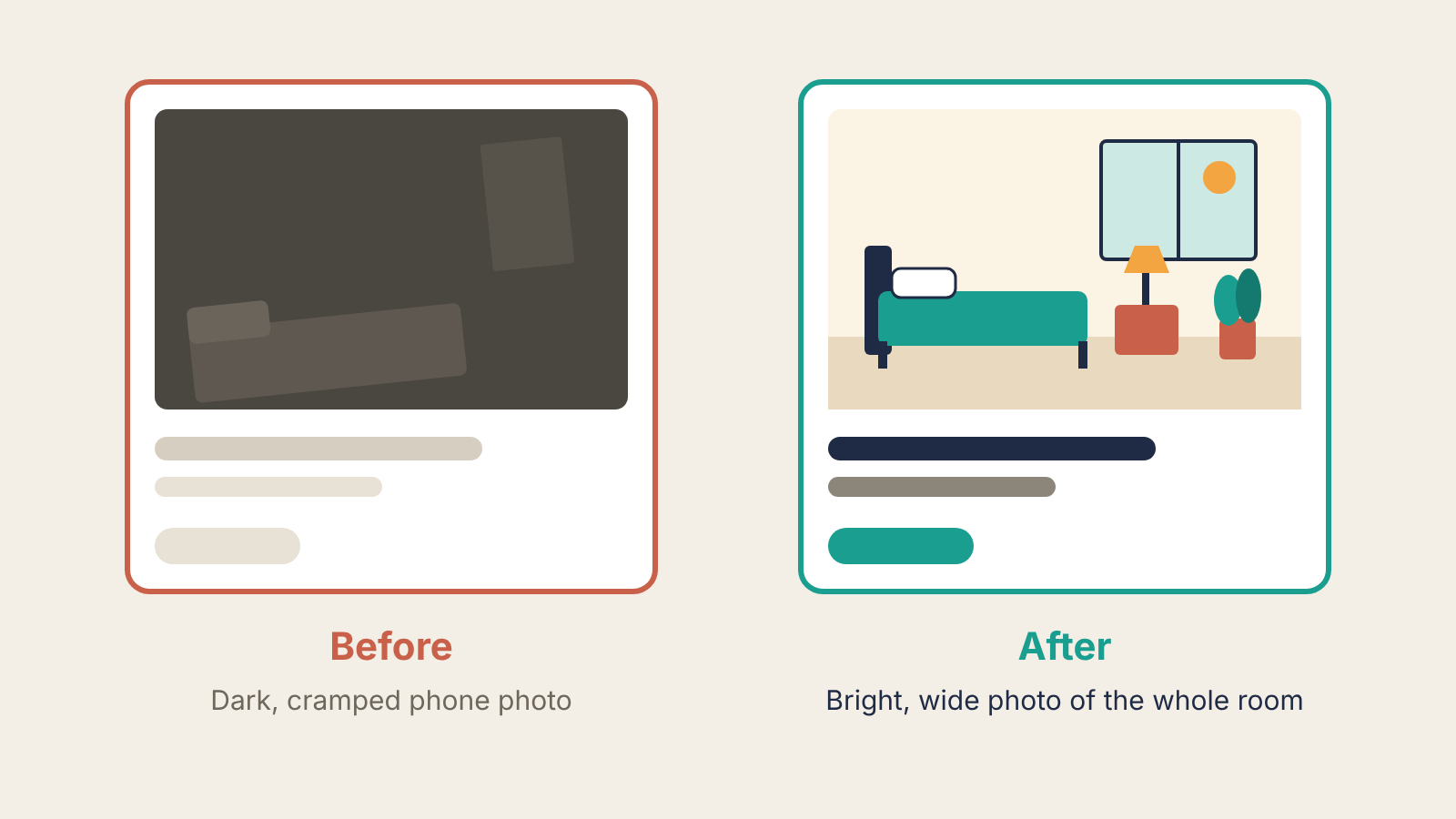
Airbnb's early fit problem was not demand for cheap places to stay. It was that its listings did not sell. In 2009, with the company making about $200 a week, the founders flew to New York, booked rooms with their own hosts, and found the same flaw again and again: the photos were bad. They photographed apartments themselves, and by Fast Company's account revenue in the city doubled within a month. This startup teardown shows what the team knew, why the fix was a diagnosis before it was a tactic, and a listing audit you can run on any marketplace this week.
The sources are Airbnb's own company history, Brian Chesky's 2015 post 7 Rejections, which publishes the investor emails from the company's 2008 raise, Fast Company's profile of the photography fix, and Joe Gebbia's 2018 CNBC interview. Most of the detail comes from founders telling the story after the company became enormous. Treat it as one well-documented case, and the revenue figures as founder recollections rather than reported accounts.
Where Airbnb started
Airbnb's history dates the first guests to October 2007, when Brian Chesky and Joe Gebbia rented space in their San Francisco apartment, on air mattresses, to visitors who could not find hotel rooms during a design conference. They called it Airbed & Breakfast. Nathan Blecharczyk joined as the third co-founder, and the company renamed itself Airbnb in March 2009.
Demand for a cheaper bed in a full city was real. The trouble was turning that into a business. In 2008 the founders tried to raise $150,000 at a $1.5 million valuation. Chesky's 7 Rejections shows what happened: of seven investors they were introduced to, five wrote back to pass and two did not reply. The company kept going through Y Combinator in early 2009, still small.
The signal
Gebbia has described revenue in that period as stuck at around $200 a week (CNBC). Flat revenue on its own tells you almost nothing. The useful signal was where the business was failing: New York had hosts and had listings, but the listings were not turning into enough bookings.
That is a specific shape. Supply existed, and people were looking. The leak was between a guest seeing a listing and choosing to book it. So the founders went to look at the listings the way a guest would, and in person. According to Fast Company, they booked stays with their New York hosts. Gebbia's verdict, in the same piece: the photos were really bad. Hosts were shooting dark, cramped phone pictures, and guests could not tell whether a room was any good.
The fix
The team rented a good camera and photographed as many New York apartments as they could, going door to door. Fast Company reports that by the end of the month revenue in New York had doubled; in the CNBC interview Gebbia puts it as going from $200 to $400 a week. Gebbia also told Fast Company: "When we fixed the product in New York, it solved our problems in Paris, London, Vancouver, and Miami."
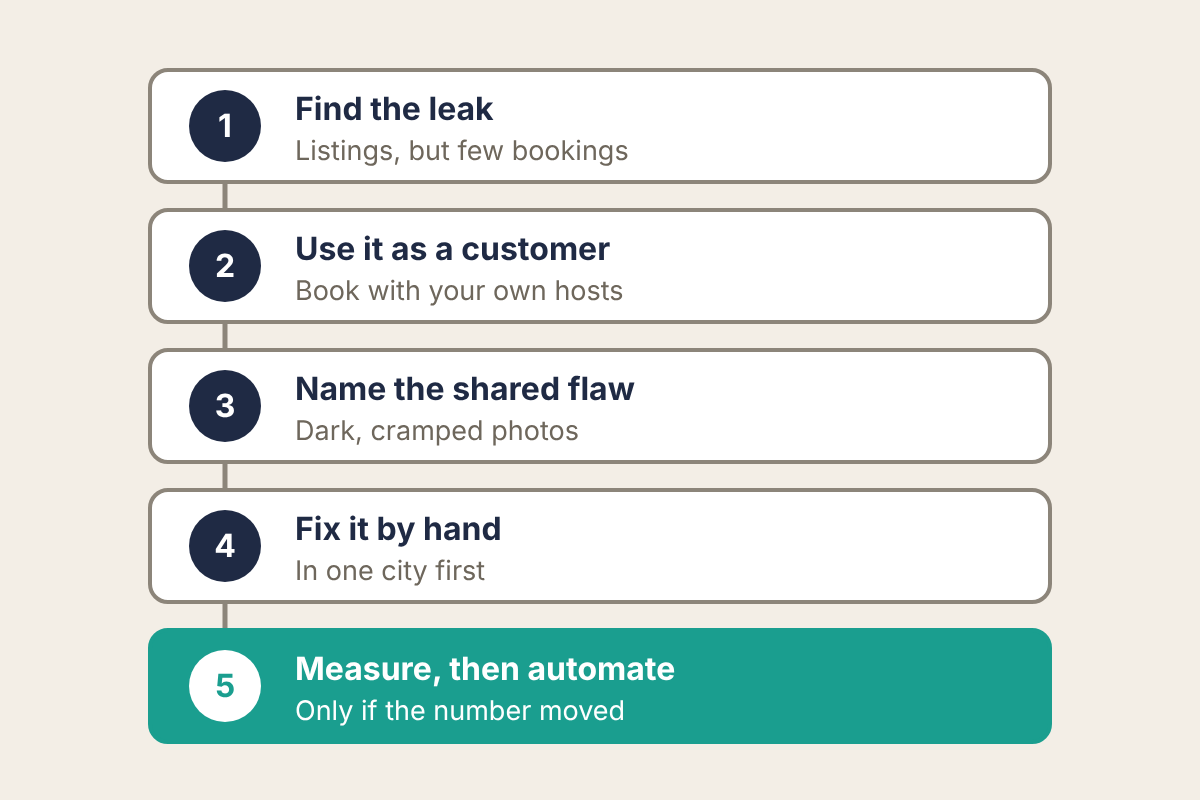
Airbnb later turned the hand-done fix into a programme that sent photographers to hosts. The order matters. They found the flaw by hand, fixed it by hand in one city, saw the number move, and only then built a system for it. That is the pattern of a concierge MVP applied to a single step of a funnel rather than to a whole product.
What they knew then versus what we know now
In hindsight, "better photos" sounds obvious. In 2009 it was one hypothesis among many. The team could have blamed prices, trust, search, the brand name or the idea itself; investors had just told them as much. What they knew was narrower: in their biggest market, listings got views and not bookings, and when they stayed in those listings themselves, the photos misrepresented the rooms.
They did not know the fix would carry to other cities, or that photography would become a permanent service. The "$200 to $400" line is also a founder's recollection, years later, of a very small number. Doubling from $200 a week can happen for many reasons in a month. The case is persuasive because the mechanism is plain, not because the measurement was rigorous. Compare the Dropbox demo video, where the founders also tested one sharp hypothesis before building anything at scale, and YouTube's pivot from a dating site, where the leak was supply, not conversion.
What to borrow: the listing gap audit
If you run a marketplace, or any product where users browse items before acting, you can find your own "bad photos" problem with numbers before you get on a plane.
The formula.
listing conversion = bookings (or purchases, or contacts) ÷ listing views
Work it out for each listing over the same 28 days, then split listings by one attribute you suspect: photo quality, description length, price band, response time.
A worked example. These numbers are illustrative, not Airbnb's. You have 200 listings in one city with 10,000 views in 28 days and 150 bookings: overall conversion 1.5%. You score each listing's main photo pass or fail (bright, wide, shows the whole room).
| Group | Listings | Views | Bookings | Conversion |
|---|---|---|---|---|
| Photo passes | 50 | 3,000 | 90 | 3.0% |
| Photo fails | 150 | 7,000 | 60 | 0.86% |
Passing listings convert at 3.0 ÷ 0.86, about 3.5 times the rate. If the failing listings converted like the passing ones, they would bring 7,000 × 3% = 210 bookings instead of 60, and the city would go from 150 to 300 bookings a month. That is the size of the prize, and it tells you what fixing the flaw by hand is worth.
Then check it in person. Correlation is not the cause: hosts who take good photos may also price better and reply faster. Book or use five failing listings yourself, as a customer would. If the flaw you scored is the thing that makes you hesitate, fix it by hand on 20 listings and compare their next 28 days with 20 similar listings you did not touch.
The threshold to watch. Act when the gap between groups is at least double and each group has 1,000 or more views; below that, a few bookings swing the rate. Our rule of thumb, not a published benchmark. If the hand-fixed listings close most of the gap, build the system. If they do not, the attribute was a proxy, and you go back to step one with customer discovery interviews.
Airbnb's founders did not find the flaw in a dashboard. They found it by staying in their own product's rooms.
