Concierge MVP: Test Demand by Delivering the Product by Hand
A step-by-step concierge MVP playbook: deliver the outcome by hand to five to ten paying customers for two to three weeks, log every step, ask them to renew, and automate only what you repeat. With a decision table and a template.
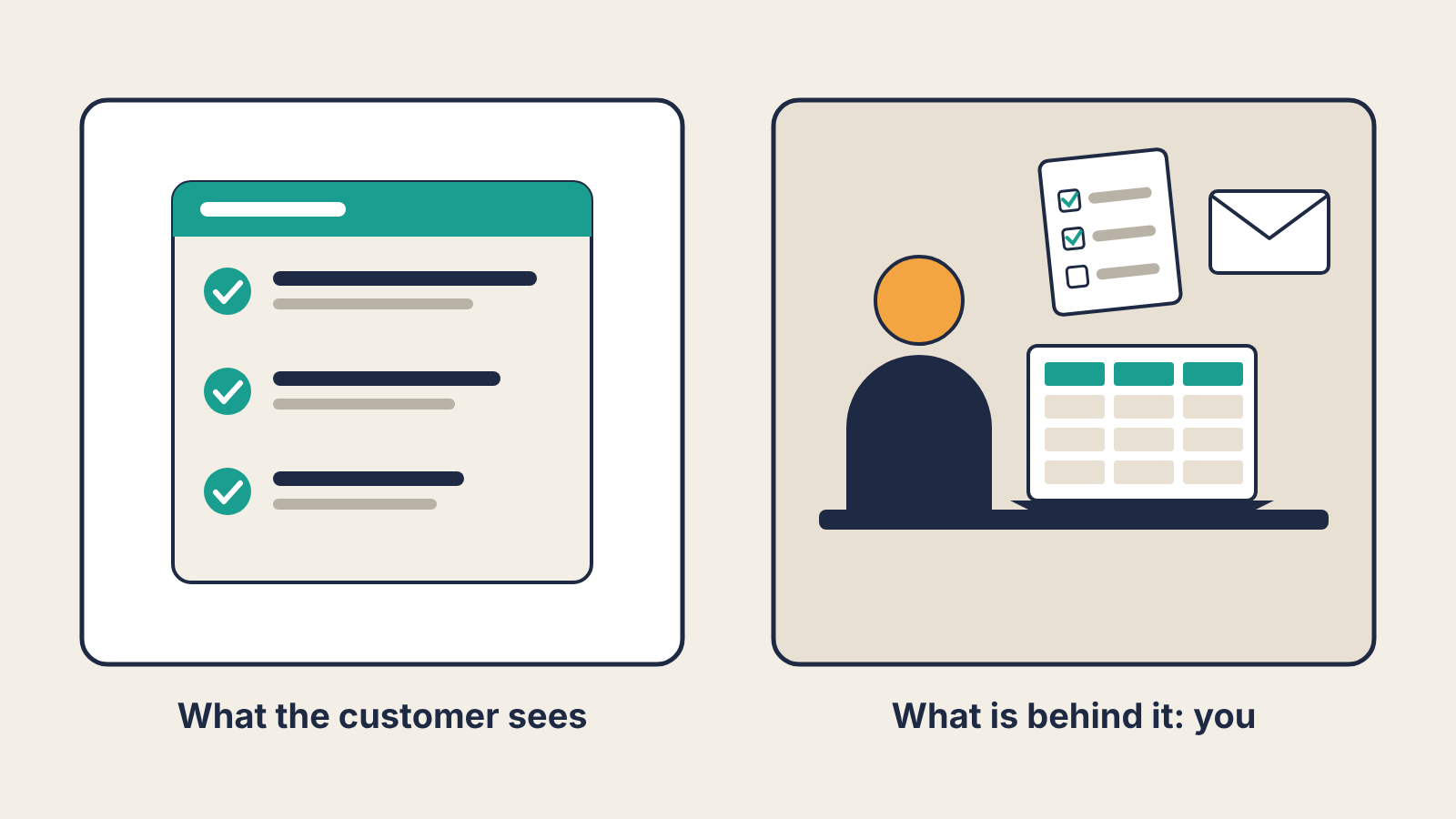
A concierge MVP is the product delivered by hand. Instead of building software, you do the job yourself for a handful of real customers, in the open, and charge them for it. In two to three weeks you learn whether people want the outcome enough to pay and come back, and you learn exactly which steps of the job are worth automating. Nothing is faked: the customer knows a person is doing the work.
It is the right test when the outcome is clear but the product would be expensive to build, and when you are not yet sure which part of the job customers value. It is the wrong test when the value is the speed or scale only software gives (instant search across a million documents cannot be done by hand) or when a demo video or smoke test would answer the question for less.
Who it is for: founders with a problem confirmed in customer discovery interviews and no product yet, or a product team testing a new service line. Time needed: two to three weeks of delivery, a few hours a day, plus two days of setup. Sample: five to ten customers. Fewer and one person's habits decide the result; more and you cannot keep up by hand.
Concierge, Wizard of Oz, or smoke test
These get mixed up, and the difference changes what you can conclude.
- A smoke test (landing page, demo video) measures interest: will people sign up for the promise.
- A Wizard of Oz test shows customers what looks like a working product while a person does the work behind it. It tests whether they will use the real interface, but it hides the manual work, so be careful about what you tell customers.
- A concierge MVP is openly manual. The customer gets the result from you, by email, call or a shared document. It tests whether the outcome is worth paying for and repeating, and it gives you the most detail about how the job is really done.
The steps
1. Write the outcome as the customer would say it
One sentence, concrete enough to deliver by hand: "Every Monday you get a shortlist of three suppliers who can make your part, with prices." Not "AI-powered sourcing". If you cannot deliver the sentence yourself in a few hours, narrow it until you can.
2. Recruit five to ten customers who match your target
Pull from your interview list first. Pick people who described the problem recently and specifically, and who have tried to solve it some other way. Tell them plainly that you are delivering this by hand while you work out what to build.
3. Charge something from day one
A small price, an upfront payment for the first month, or a pilot fee all work. The amount matters less than the act of paying: free users accept a service they would never buy. If you cannot bring yourself to charge, write down why; it is often a sign the outcome is not yet clear.
4. Deliver by hand and log every step
Keep a simple log for every delivery: what you did, in what order, how long each step took, and what the customer asked for that you had not planned. This log is the most valuable output of the whole test. It becomes your first product spec.
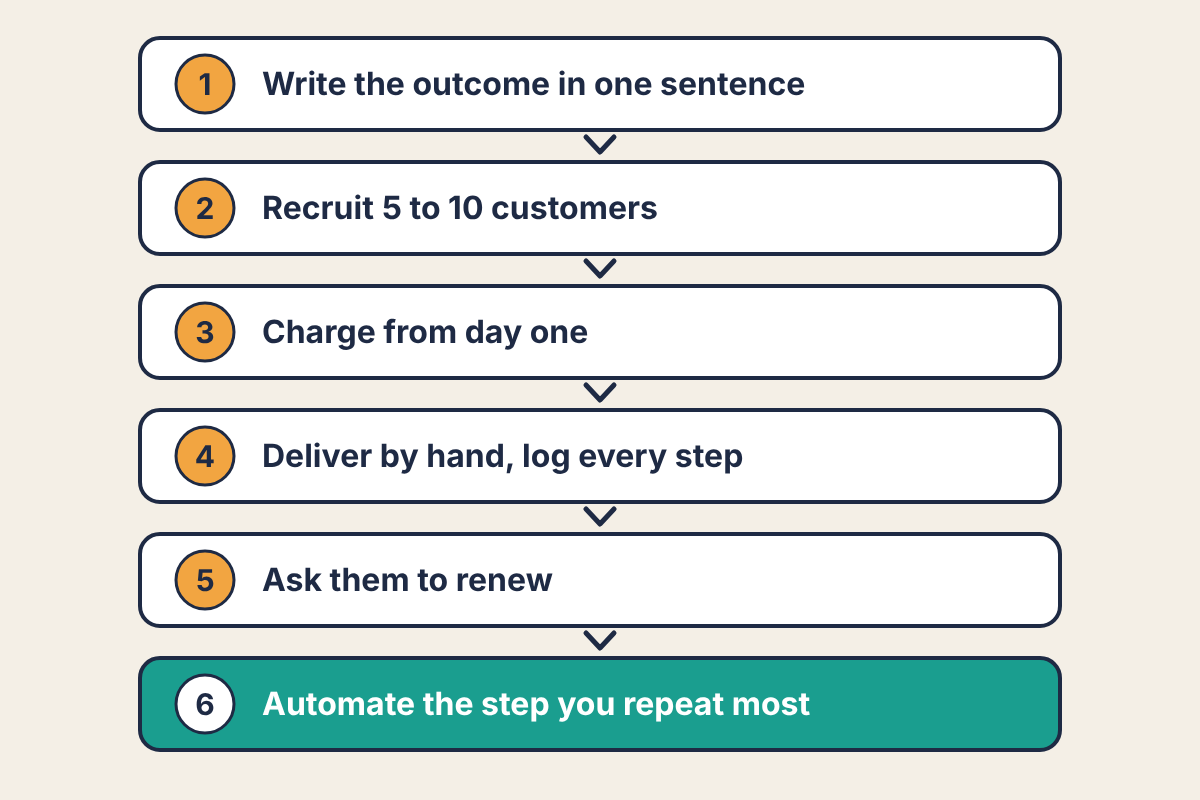
5. Ask them to renew
At the end of the first cycle, ask each customer to continue for another cycle at the same or a higher price. Renewal is the result you are testing. A customer who loved the first delivery but does not renew has told you the outcome is nice, not needed.
6. Automate the step you repeat most
Read the log. Find the step that took the most time and was the same for most customers. Build software for that one step first, keep doing the rest by hand, and run another cycle.
Reading the result
Set your thresholds before you start, not after. A reasonable starting rule for five to ten customers:
| Result after one cycle | What it suggests | Next move |
|---|---|---|
| Most paid and most renewed | The outcome is wanted and repeatable | Automate the most repeated step and add customers |
| Most paid, few renewed | The first result was interesting, not needed | Ask the non-renewers what they did instead; change the outcome |
| Few would pay at all | Interest without need, or the wrong customers | Back to interviews, or a narrower customer group |
| Every customer needed something different | No repeatable product yet | Find the subgroup whose requests matched and serve only them |
With eight customers, one renewal moves the renewal rate by 12.5 points (1 ÷ 8). Treat the table as a guide to the next conversation, not a verdict.
Mistakes that ruin the test
- Doing it for free. You learn about goodwill, not demand.
- Over-delivering. If you add personal touches you could never automate, customers are buying you, not the product. Log anything you do that would not survive automation.
- Picking friends. Friends renew to be kind. If you must include them, count them separately.
- Running it too long. Two or three cycles answer the question. Past that, you are running a services business and should decide whether that is what you want.
The template to run this week
Copy this into a document and fill it in before you contact anyone:
- Outcome sentence: "Every you get , so that ___."
- Customers: names of 5 to 10 people from your interviews who described the problem in the last month.
- Price for the first cycle: , paid (upfront / at delivery).
- Cycle length: ___ (one or two weeks).
- Delivery log columns: date, customer, step, minutes, unplanned request.
- Renewal threshold: at least of customers renew at the same price.
- Decision date: ___. On that day, use the table above and pick one next move.
When renewals come in, start measuring the customers who stay the way you would any product: their retention over time, not just the first purchase.
