Landing Page Smoke Test: Validate a Startup Idea in a Week
A step-by-step landing page smoke test: one promise, one button, a bar you set before launch, the margin-of-error maths for small samples, and a checklist to run this week.
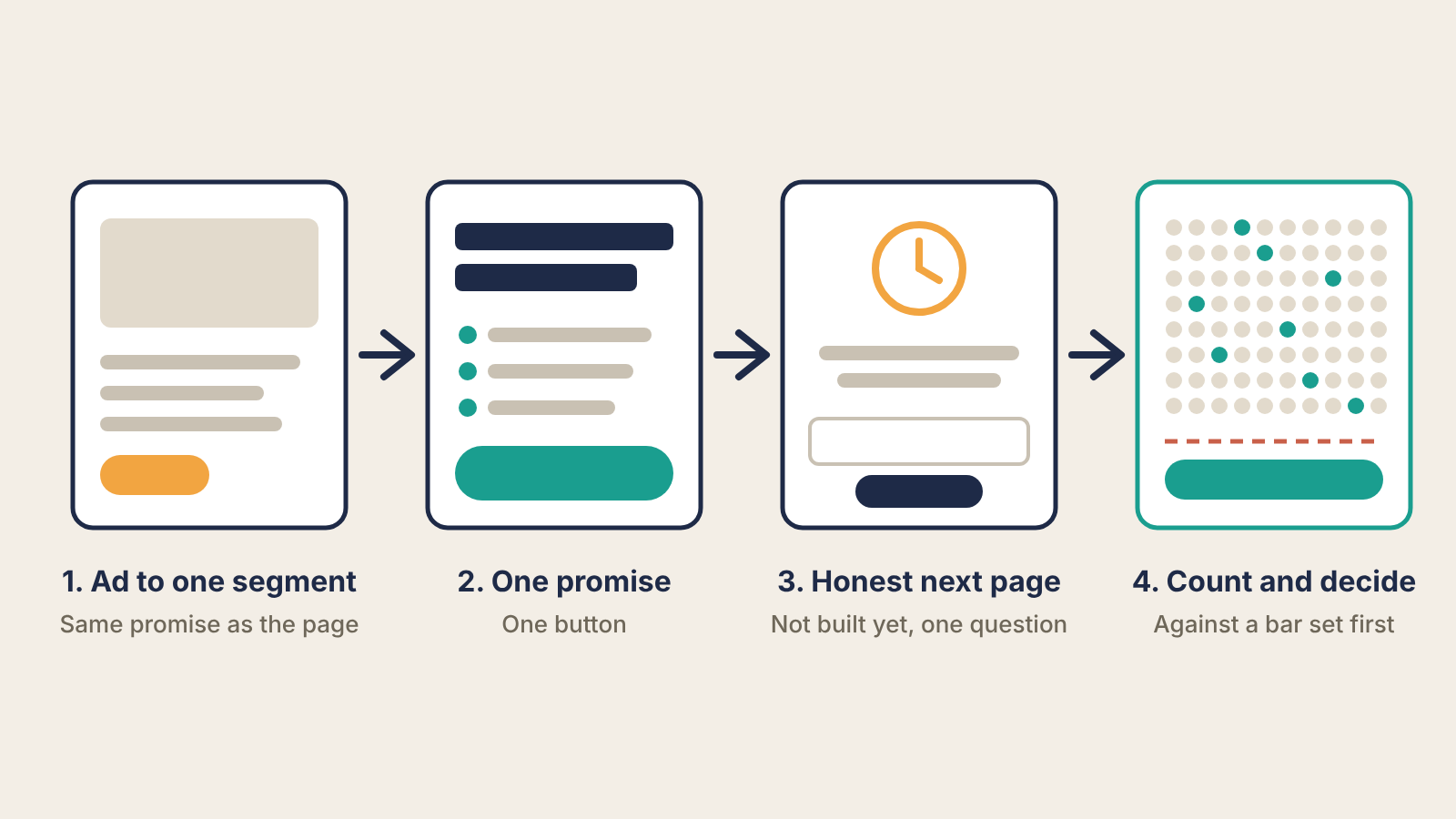
A landing page smoke test checks whether the people you think have a problem will act on your promise to solve it, before you build anything. You write one page that makes one promise, send a few hundred people from one segment to it, and count how many take a real step: leave an email with an answer to a question, book a call, or put down a refundable deposit. The test takes about a week and works best when you already have a specific problem from interviews and need to know whether strangers care enough to act.
What it can tell you is narrow. A smoke test measures interest in a promise. It says nothing about whether your product will keep that promise or whether people will keep using it; that is what a concierge MVP and later a retention curve are for. Dropbox's famous demo video is the same idea in video form, and our teardown of it separates what a demand test proves from what it cannot.
- Who it is for: founders with a problem and a segment already named, usually after 10 or more discovery interviews.
- Time needed: one day to build, five to seven days of traffic, one day to follow up and decide.
- Sample: a few hundred visitors from one segment. Fewer than about 200 and the result is mostly noise (the maths is below).
Step 1: Write the promise and the segment in one sentence each
The promise is the outcome, not the feature list: "Close your month-end books in one afternoon" rather than "AI-powered reconciliation with 40 integrations". The segment is who you will send: "finance leads at agencies with 20 to 100 staff", not "SMBs".
If your customer discovery interviews gave you the words people used to describe the problem, use those words. A smoke test of your own vocabulary tells you less than a test of theirs.
Step 2: Choose the action you will count
Pick the strongest commitment you can ask for honestly, because a stronger action filters out polite interest:
- Email only. Cheap to give, so it overstates demand. Use it only if nothing stronger fits.
- Email plus one qualifying question ("How do you do this today?"). Better: the answers tell you whether sign-ups are in your segment.
- Book a 20-minute call. Strong, and it hands you interviews.
- Refundable deposit or pre-order. Strongest. Only ask for money if you will refund it promptly when you do not ship, and say so on the page.
Count one action. Report the others, but decide on one.
Step 3: Build a page with one promise and one button
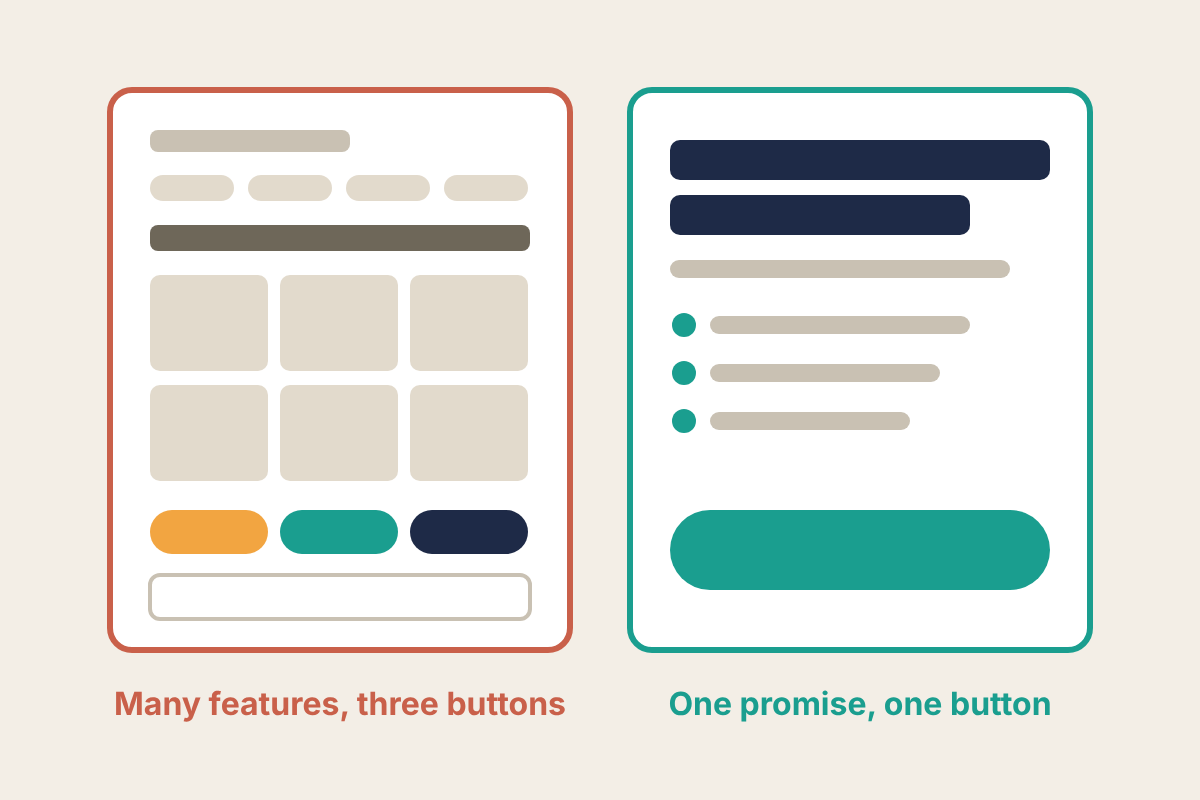
The page needs a headline with the promise, a line saying who it is for, three short points on what changes for them, and a single button. No navigation, no pricing table unless price is what you are testing, no second call to action. Every extra choice splits the signal, and when the result comes back low you will not know which part people rejected.
The button leads to an honest page: the product is not built yet, here is what happens next, and here is the one question or the calendar link. Do not show a fake checkout or pretend the product exists. People who feel tricked do not answer follow-up emails, and misleading ads break most ad platforms' policies. Tell sign-ups what you will do with their email and do nothing else with it.
Step 4: Set the bar before any traffic arrives
Decide what result means "build", "rework" and "stop" before you see a number. Afterwards, any result looks encouraging.
One way to set the bar is to work back from what the business needs. These numbers are illustrative:
- You need 50 paying customers in three months for the product to be worth building.
- You can realistically reach 2,000 people from this segment in that time.
- You assume one in four sign-ups would pay. That is an assumption to test later, not a fact.
Bar = customers needed ÷ (reachable visitors × sign-up-to-paid rate) = 50 ÷ (2,000 × 0.25) = 10%
So a sign-up rate around 10% or more means "build", well under it means "rework the promise or the segment", and near zero means "stop". This is a rule of thumb for deciding, not a published benchmark; general landing-page conversion rates come from different pages and traffic, so they are not a fair bar for yours.
Step 5: Send traffic from one segment
Paid search or social ads targeted at the segment give you the cleanest sample, because you choose who sees the page. Posting in communities where the segment gathers also works, if the community's rules allow it and you say plainly that you are testing an idea. Avoid sending friends, followers or your own network: they click because they know you.
Keep the ad's wording the same as the page headline. If the ad promises one thing and the page another, you are testing the mismatch.
Step 6: Read the result with its margin of error
The rate is sign-ups ÷ unique visitors from the segment. Small samples swing, so put a margin on it before you compare it with the bar:
margin ≈ 1.96 × √(rate × (1 − rate) ÷ visitors)
Worked example: 400 visitors and 32 sign-ups give 8%. The margin is 1.96 × √(0.08 × 0.92 ÷ 400) ≈ 2.7 points, so the true rate is likely somewhere between about 5% and 11%. Against a 10% bar that is "unclear, run longer or sharpen the promise", not "build".
With 100 visitors and 5 sign-ups the margin is about 4.3 points around 5%: the test cannot tell 1% from 9%. This is why a few hundred visitors is the minimum, and why comparing two page versions needs far more traffic than testing one.
Step 7: Talk to the people who signed up
The sign-up count is half the result. Within two days, email every sign-up and ask for a short call, using your discovery script. You want to know how they handle the problem today, what they have tried, and what made them click. If most sign-ups turn out to be outside your segment, the rate overstated demand; if they describe the problem in your words without prompting, it may have understated it.
Your checklist for this week
- Promise sentence and segment sentence, in your interviewees' words.
- One counted action, the strongest you can ask for honestly.
- A page with one headline, three points and one button, and an honest "not built yet" page behind it.
- The bar written down, with the assumption behind it, before launch.
- Ads or community posts aimed at the segment only, same wording as the page.
- At least 300 to 400 unique visitors from the segment, then rate and margin.
- A call request to every sign-up within two days, and a decision: build, rework or stop.
